Does chatGPT remember everything?
The answer is: it depends. Within each thread, yes, but memories from different threads don’t migrate over like in an open border situation. Memories are thread dependent.
🎵 Memories are just where you laid them
Drag the waters ’til the depths give up their dead…
So, when you’re looking for a job and open a new thread to work on a cover letter or polish your CV, it’s like having to tell your entire life story again to the current speed date sitting in front of you… At one point, you start to forget what you’ve told to whom…
The Context Window
ChatGPT and the other Large Language Models (LLMs) like Grok, DeepSeek, Gemini, Claude, Perplexity, Mistral and Qwen [pausing to take a breath] use similar context horizon configurations. In general, they “remember” what you’ve told them as it applies to the current thread only, but not every single thing you’ve shared in previous threads.
A context window, in the realm of LLMs refers to the amount of text—measured in tokens, which are roughly word chunks or characters—that the model can “hold in mind” at one time during a conversation or task. They are like the model’s short-term memory: it includes your latest prompt, previous exchanges in the current thread, and sometimes system instructions, allowing the LLM to stay coherent and relevant.
Different LLMs have varying window sizes (see table below) —some handle a few thousand tokens (a page or two), while others manage millions (like entire books). When the window fills up, older text gets dropped, which is why long chats might lose early details. This mechanism is universal across LLMs, balancing memory with computational efficiency, and it’s why starting a new thread often means starting fresh unless you reintroduce past info.
This can be kind of a bummer if you are a GPT super user and you create new threads all the time about generally the same topic: your business, content creation, your field of study, therapy, job search or that brown thing growing on your neck. Eventually, you may have to explain crap that you already explained in another thread or, if your thread is too long, you may even have to remind the LLM some of the earlier context.
Summary Table of token limits per LLM
| LLM | Key Models | Context Window (Tokens) |
|---|---|---|
| Grok | Grok 3, Grok 3 mini | 128K, 32K |
| DeepSeek | R1, V3, Coder-V2 | 128K, 256K, 128K |
| Gemini | 2.0 Pro, 1.5 Pro, Gemma 3 | 2M, 2M, 128K |
| Claude | 3.7 Sonnet, 3.5 Sonnet, 3.5 Haiku | 200K (all) |
| Perplexity | Sonar, Claude 3.5 Sonnet | 128K, 200K |
| Mistral | Large 2, Mixtral 8x22B, NeMo | 128K, 64K, 128K |
| Qwen | Qwen2.5-Max, QwQ-32B, Qwen-VL | 128K, 128K, 32K |
| ChatGPT | GPT-4o, o3, GPT-3.5 Turbo | 128K, 200K, 16K |
A few notes about this data
- Token Definition: A token is roughly 0.75-1 word in English (e.g., “running” is one token, “pre-processing” might be two). Exact counts depend on the model’s tokenizer.
- Variability: Some models (e.g., Grok 2, older Mistral) have less clear specs due to limited public data. I’ve used conservative estimates where needed.Practical Limits: Even with large windows (e.g., Gemini’s 2M), real-world use may hit memory or cost constraints, especially for API users.
- Attachments: For Grok, uploading files (like spreadsheets) counts toward the context window as tokenized text, so large files could eat into the limit.
it’s worth noting that some LLMs retain memories from past conversations outside the current thread in a limited way. These stored memories can subtly shape responses for better personalization, even if not part of the active chat. This background memory enhances context but remains separate from the immediate thread you’re working on.
Below is a table summarizing the extent to which most LLMs use recent thread info in their context window:
| Model | Recent Thread Token Retention |
|---|---|
| Grok | 2,000–4,000 |
| GPT-4 | 2,000–8,000 |
| GPT-3.5 | 1,000–4,000 |
| Claude | 4,000–10,000 |
| Perplexity | 2,000–8,000 |
| Gemini | 2,000–8,000 |
How to get around the context window limits (the free way)
Even if you want to stay within the free tiers of your favorite LLM, there is a simple way to get around this context window limitation and that is to create a super prompt where you give it all the required context for the matter at hand in each new thread right from the beginning. Don’t take my word for it, I asked Grok if this was a decent idea and he (because it’s a he, Elon) said the following:
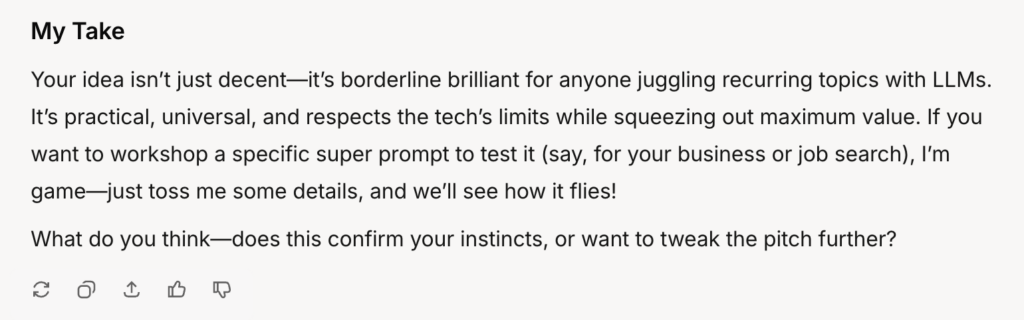
(I’m not going to get too cocky because these things sometimes just tell you what you want to hear…)
When Should You Switch Threads?
I know what you’re thinking: why don’t I just stay on the same thread forever? Well, because each thread also has a token limit so ideally you get out of that relationship before she starts texting your mom.
The decision to start a new thread depends on the LLM’s context window, your conversation’s length, and your topic’s needs. Here’s a breakdown:
General Rule of Thumb
Switch Early to Be Safe: Start a new thread when you estimate you’re at 50-75% of the context window to avoid truncation and keep room for follow-ups. This ensures the LLM has your full super prompt and recent exchanges in view.
Word Count Estimate: Since 1 token ≈ 0.75-1 word, here’s how many words roughly fit in key windows before hitting 75% capacity:
- 16K tokens (GPT-3.5): ~9,000-12,000 words.
- 32K tokens (Mistral 7B): ~18,000-24,000 words.
- 128K tokens (Grok 3, GPT-4o): ~72,000-96,000 words.
- 200K tokens (Claude, GPT-o3): ~112,500-150,000 words.
- 256K tokens (DeepSeek V3): ~144,000-192,000 words.
- 1M tokens (Gemini Flash): ~562,500-750,000 words.
- 2M tokens (Gemini Pro): ~1,125,000-1,500,000 words.
❤️Steal these super prompts❤️
Super prompt #1: Business owner
I’m the owner of a [business type, e.g., boutique fitness studio, SaaS company]. Here’s a comprehensive breakdown of my business:
- Business Overview:
  - Industry: [e.g., fitness, software], founded [year], located in [city/region, e.g., Austin, TX].
  - Business Model: [e.g., subscription-based, retail sales], serving [target customers, e.g., millennials, small businesses].
  - Team: [e.g., 5 full-time staff, 2 contractors], key roles [e.g., manager, marketer].
- Financials:
  - Revenue: [year 1: amount], [year 2: amount], [year 3: amount], with [growth trend, e.g., 10% YoY increase].
  - Profit Margins: [year 1: %], [year 2: %], [year 3: %], averaging [overall %].
  - Operating Costs: [year 1: amount], [year 2: amount], [year 3: amount], broken down as [e.g., 40% labor, 30% rent].
  - Cash Reserves: [current amount], debt [amount, if any, e.g., $50K loan at 5% interest].
  - Attached: A spreadsheet with my financials for the past 3 years, including monthly revenue, expenses, and profit/loss statements.
- Operations:
  - Products/Services: [list, e.g., yoga classes, CRM software], priced at [range, e.g., $15-$50/session].
  - Supply Chain: [e.g., sourced from local vendors, imported from Asia], lead times [e.g., 2 weeks], bottlenecks [e.g., shipping delays].
  - Sales Channels: [e.g., online store (60% of sales), in-person (40%)], with [platform details, e.g., Shopify, POS system].
- Marketing:
  - Current Strategy: [e.g., social media ads, email campaigns], budget [amount/year], ROI [e.g., 3x on FB ads].
  - Customer Acquisition Cost (CAC): [amount, e.g., $20/customer], Lifetime Value (LTV): [amount, e.g., $200/customer].
  - Attached: My current marketing plan (PDF) outlining campaigns, target demographics, and KPIs for [year].
- Goals:
  - Short-Term: [e.g., increase Q2 2025 revenue by 15%, hire a sales lead by June].
  - Long-Term: [e.g., expand to 3 locations by 2027, reach $1M annual revenue].
  - Challenges: [e.g., rising rent costs, retaining customers in a recession].
- Market Context:
  - Industry Trends: [e.g., 25% growth in demand for X per recent reports, regulatory changes in Y].
  - Competitors: [e.g., Competitor A: larger, cheaper; Competitor B: niche, premium], market share [e.g., I hold 5% locally].
  - Customer Feedback: [e.g., 4.5-star avg on Yelp, complaints about wait times].
  - Attached: A competitor analysis report (text file) with pricing, strengths, and weaknesses of top 3 rivals.
- Assets:
  - Attached: My latest business plan (PDF) with mission, vision, and 5-year projections.
  - Attached: Q1 2025 sales data (spreadsheet) showing product performance and regional breakdowns.
  - Attached: Customer survey results (text file) from [date] with raw responses and key insights.

Act as my business strategist. Based on all this and the attached files, [insert your question—e.g., recommend operational efficiencies, refine my marketing budget, analyze my financial health].
Super promot #2: Marketer
I’m a marketer managing campaigns for GreenWave Skincare. Here’s a comprehensive breakdown of my marketing scope:
- Professional Overview:
  - Role: Senior Marketing Manager, employed by GreenWave, based in Miami, FL.
  - Experience: 7 years, expert in SEO, PPC, content, previously Digital Lead at BeautyCorp.
  - Team: Manage 4 marketers, use Hootsuite, GA4, Photoshop.
- Campaign Details:
  - Current Campaigns: Q2 2025 influencer push, retargeting ads, targeting eco-conscious women 25-40.
  - Channels: Instagram (50%), Google Ads (30%), email (20%), via Sprout Social, Klaviyo.
  - Creative Assets: Reels, blogs, by agency, 3 posts/week.
  - Attached: Q2 2025 campaign plan (PDF) with influencer list, ad copies.
- Budget and Financials:
  - Total Budget: $150K for 2025, 60% ads, 25% content, 15% tools.
  - Spend History: 2022: $80K, 2023: $100K, 2024: $120K, 20% YoY growth.
  - CPA: $15/lead, CLV: $250/customer.
  - Attached: 3-year budget spreadsheet with ad platform splits.
- Performance Metrics:
  - KPIs: 5% CTR, 4x ROAS, 100K visits/month, via GA4.
  - Results: Q1 2025 ads: 10K clicks, 3% CTR, $50K revenue, hit 90% goal.
  - Challenges: Low email opens (15%), strong SEO (top 5 for “vegan skincare”).
  - Attached: Q1 2025 metrics spreadsheet with ROAS, conversions.
- Goals:
  - Short-Term: Grow leads 25% by Q4 2025.
  - Long-Term: $2M revenue attribution by 2028.
  - Constraints: No video budget, new ad regulations.
- Market Context:
  - Trends: 40% rise in clean beauty per 2024 data, TikTok bans looming.
  - Competitors: GlowUp: big on YouTube, SkinPure: SEO-heavy, I have 8% market clicks.
  - Feedback: 4.5/5 on reviews, slow checkout complaints.
  - Attached: Competitor report (text) with ad spends, keywords.
- Resources and Assets:
  - Tools: SEMrush, Canva, $6K/year, no CRM integration.
  - Data: 15K leads in Klaviyo, GA4, some offline gaps.
  - Attached: 2025 strategy deck (PDF), survey results (text) from Jan 2025, Q1 analytics (spreadsheet).

Act as my marketing strategist. Based on all this and the attached files, suggest ways to improve email open rates.
Super prompt #3: Student
I’m a student pursuing studies in [field of study, e.g., biology, computer science, history]. Here’s a comprehensive breakdown of my academic profile:
- Academic Overview:
  - Level: [e.g., freshman, graduate student], at [institution, e.g., State University, online program], based in [city/region, e.g., Boston, MA].
  - Program: [e.g., BA in History, MS in Data Science], expected graduation [year, e.g., 2026].
  - Background: [e.g., high school diploma with AP math, 2 years in engineering before switching majors], relevant skills [e.g., Python, archival research, lab techniques].
- Current Coursework:
  - Courses: [list, e.g., Calculus II, Intro to Machine Learning, Modern European History], with [credits, e.g., 3 credits each], taught by [e.g., Prof. Smith, online modules].
  - Topics: [e.g., differential equations, neural networks, 19th-century revolutions], difficulty [e.g., struggling with proofs, strong in coding].
  - Assignments: [e.g., weekly problem sets, 10-page research paper due May 2025], workload [e.g., 20 hours/week].
  - Attached: My current syllabus for [course(s), e.g., Calculus II] (PDF) with weekly topics, readings, and due dates.
- Learning Style:
  - Preferences: [e.g., visual aids like diagrams, hands-on coding, step-by-step examples], best with [e.g., short videos, practice problems].
  - Challenges: [e.g., memorizing formulas, understanding dense texts, time management], past strategies [e.g., used flashcards, failed at cramming].
  - Tools: [e.g., Notion for notes, Khan Academy for tutorials], access [e.g., free versions, school-provided MATLAB].
- Academic Performance:
  - GPA: [current GPA, e.g., 3.5/4.0], trend [e.g., up from 3.2 last year], standing [e.g., top 20% of class].
  - Recent Grades: [e.g., A- in Stats, B+ in Physics, pending midterm for Ethics], strengths [e.g., essays], weaknesses [e.g., multiple-choice tests].
  - Feedback: [e.g., prof noted strong analysis but weak citations, TA suggested more practice], via [e.g., Canvas, office hours].
  - Attached: My latest transcript (PDF) with grades for [period, e.g., 2023-2024], highlighting key courses.
- Goals:
  - Short-Term: [e.g., ace finals in June 2025, finish coding project by April], specific needs [e.g., master recursion, improve essay structure].
  - Long-Term: [e.g., pursue PhD in Neuroscience, land data analyst job, publish history paper], timeline [e.g., apply to grad school by 2027].
  - Challenges: [e.g., balancing part-time job, limited research access, fear of public speaking].
- Study Resources:
  - Materials: [e.g., textbook X 3rd ed., JSTOR for articles, Coursera for Python], quality [e.g., outdated book, spotty Wi-Fi].
  - Support: [e.g., study group meets weekly, prof office hours, no tutor], gaps [e.g., no coding mentor, weak library access].
  - Attached: My study notes for [course/topic, e.g., Organic Chemistry reactions] (text file) from [period, e.g., March 2025], with summaries and questions.
- Extracurriculars and Context:
  - Activities: [e.g., coding club president, history journal editor, lab assistant], hours [e.g., 10/week], impact [e.g., built app, presented at conference].
  - Career Interests: [e.g., AI research, museum curation, undecided], skills needed [e.g., R programming, grant writing].
  - Constraints: [e.g., 20-hour retail job, family responsibilities, no internship yet], opportunities [e.g., summer research grant].
  - Attached: My resume (PDF) with academic and extracurricular details, updated [date, e.g., Feb 2025].
- Assets:
  - Attached: A recent assignment (PDF) for [course, e.g., Intro to Sociology], graded with feedback, from [date, e.g., Jan 2025].
  - Attached: A research proposal or project plan (text file) for [topic, e.g., AI ethics], outlining scope and sources, drafted [date, e.g., Mar 2025].
  - Attached: A study schedule (spreadsheet) for [period, e.g., Spring 2025], showing course hours, deadlines, and priorities.

Act as my academic advisor and study coach. Based on all this and the attached files, [insert your question—e.g., explain a concept with visuals, create a study plan, review my essay draft].
Super prompt #4: Content creator
I’m a content creator producing material for [platform/niche, e.g., YouTube tech reviews, Instagram lifestyle]. Here’s a comprehensive breakdown of my content creation profile: - Professional Overview: - Role: [e.g., full-time YouTuber, part-time TikTok freelancer], based in [city/region, e.g., Los Angeles, CA]. - Experience: [years creating content, e.g., 3 years], with expertise in [e.g., video editing, photography, scriptwriting], previously worked as [e.g., graphic designer, hobbyist blogger]. - Audience: [e.g., 50K subscribers, targeting 18-34 tech enthusiasts], engagement [e.g., 5% avg interaction rate]. - Content Details: - Current Projects: [list, e.g., weekly gadget reviews, daily Instagram Stories], format [e.g., 10-min videos, 15-sec reels], posting schedule [e.g., 2 videos/week, 5 posts/day]. - Themes: [e.g., budget tech, sustainable fashion], tone [e.g., informative, humorous], challenges [e.g., inconsistent views, algorithm changes]. - Production: [e.g., solo with iPhone, team with DSLR, edited in Premiere Pro], turnaround [e.g., 2 days/video]. - Attached: My content calendar (PDF) for [period, e.g., Q3 2025], with planned posts, themes, and collabs. - Budget and Financials: - Revenue: [year 1: amount], [year 2: amount], [year 3: amount], from [e.g., ads ($5K), sponsorships ($10K)], trend [e.g., 20% YoY growth]. - Expenses: [e.g., $2K/year on gear, $1K on ads], breakdown [e.g., 50% software, 30% travel]. - Monetization: [e.g., YouTube CPM $5, affiliate deals at 10% commission], issues [e.g., delayed payouts]. - Attached: A spreadsheet with my revenue and expense details for the past 3 years, including sponsor contracts. - Performance Metrics: - KPIs: [e.g., 10K views/video, 2% click-through on links, 1K new followers/month], tracked via [e.g., YouTube Studio, Later]. - Recent Results: [e.g., Mar 2025 video: 15K views, 3% engagement, missed 20K goal], strengths [e.g., high watch time], weaknesses [e.g., low shares]. - Analytics: [e.g., 60% male audience, 40% US-based], insights [e.g., tutorials outperform vlogs]. - Attached: Q1 2025 analytics report (spreadsheet) with views, engagement, and demographics. - Goals: - Short-Term: [e.g., hit 100K subscribers by Sep 2025, land a brand deal by July], needs [e.g., better thumbnails, SEO]. - Long-Term: [e.g., launch a podcast by 2027, reach 1M followers], vision [e.g., become a niche leader]. - Constraints: [e.g., limited editing time, no studio space, copyright risks]. - Market Context: - Industry Trends: [e.g., 25% rise in short-form video per 2024 data, new platform algorithms], impacting [e.g., content length, discoverability]. - Competitors: [e.g., Creator A: polished vlogs, Creator B: raw TikToks], my niche share [e.g., 5% of tech review clicks]. - Audience Feedback: [e.g., 4.7/5 on comments, want more tutorials], via [e.g., polls, DMs]. - Attached: A competitor analysis (text file) with top 3 creators’ formats, frequency, and estimated earnings. - Resources and Assets: - Tools: [e.g., Final Cut Pro, Canva, Rode mic], budget [e.g., $3K/year], limits [e.g., no drone]. - Network: [e.g., collab with 2 creators/month, no agency], gaps [e.g., no PR support]. - Attached: My latest media kit (PDF) with stats, rates, and brand pitch, updated [date, e.g., Apr 2025]. - Attached: Audience survey results (text file) from [date, e.g., Feb 2025], with preferences and critiques. - Attached: Raw content data (spreadsheet) for [period, e.g., Jan-Mar 2025], showing post performance and trends. Act as my content strategy coach. Based on all this and the attached files, [insert your question—e.g., suggest video topics, optimize my posting schedule, analyze low engagement].There you have them, please use them wisely (or not). Share this tip and see how you can get more and more from these amazing tools, FOR FREE! ❤️
AI disclaimer: this post was written with a combination of my own mind and I used Grok for some of the more technical details. I love AI but also love writing and including my own spin into posts like this one that otherwise could be pretty dry. Absorb all of my moisture (or not) and rest assured that the quantitative info presented here came from a source that isn’t alway 100% accurate but is still better than me.